
The Alid Tradition of Seeking Spiritual Enlightenment
Bismillahir Rahmanir Rahim
In the name of Allah, the Most Beneficent, the Most Merciful
Ya Ali Madad, Yawm-e Ali Mubarak! On the occasion of the birthday commemoration of our first Holy Imam, Amir al-mu’minin, Noor Mowlana Murtaza Ali (alayhi salaam) , we would like to extend heartfelt felicitations to the global Jamat.
On this day, may Noor Mowlana Shah Rahim Al-Hussaini Hazar Imam, the 50th direct lineal descendant of the Holy Prophet (s.a.s.), bless the global Jamat with peace, prosperity, happiness, barakat, higher spiritual enlightenment, spiritual & luminous tayid (help) and empowerment. Ameen.
Allâhumâ salli alâ Muhammadin wa âle Muhammad
(O Allah! Bestow Peace on and through Muhammad and his Descendants).
Introduction
This post has nine parts:
- Ismaili View of Prophecy and Imamat;
- Revelation of Esoteric Truths;
- The Distinction Between Exoteric and Esoteric;
- The Search for Inner Mysteries of the Faith;
- The Imam is the Bearer of Nur;
- The Creation and Nature of the Soul;
- The Diversity of Soul;
- Ascent of the Soul Towards the Rank of the Sound Heart; and
- Being in the Presence of Lord (Mawla-y-i khud), Murtada ‘Ali.
1. Ismaili View Of Prophecy and Imamat
Here is an excerpt from the book titled ‘Ismaili Contributions to Islamic Culture’:
The Ismaili view of prophecy and the Imamat was based on belief in the permanent need of mankind for a divinely guided, impeccable leader and teacher to given it justly and to direct it soundly in religion. In the absence of a prophet, this was the function of the Imam. The Imamat thus was part of the prophetic chain which spans the history of man from the beginning to the end. This belief about the significance of the Imamat was part of the heritage which Ismailism carried on from the earlier Shia.
Wilfred Madelung. 1977. Aspects of Ismaili Theology: The Prophetic Chain and God beyond Being. Pp. 54-55 in Ismaili Contributions to Islamic Culture, edited by Seyyed Hossein Nasr, Imperial Iranian Academy of Philosophy. Tehran
2. Revelation of Esoteric Truths
Here is an excerpt from the book titled ‘Ismaili Contributions to Islamic Culture’:
The esoteric truths (haqa’iq) which the divinely guided members of the prophetic chain dispensed were essentially gnostic. These were based on revelation and transcended human reason, though they gave the rational soul its perfection and this lead man to his “second creation” (khalq thani). The human intellect could not reach them by its own independent efforts. Only by initially turning to the guidance of the Prophets and Imams could man partake of the divine support (ta’yid) through which their teaching would become salvatory revelation for him.
Wilfred Madelung. 1977. Aspects of Ismaili Theology: The Prophetic Chain and God beyond Being. P.55 in Ismaili Contributions to Islamic Culture, edited by Seyyed Hossein Nasr, Imperial Iranian Academy of Philosophy. Tehran
3. The Distinction Between Exoteric and Esoteric
Here is an excerpt from the book titled ‘Ismaili Contributions to Islamic Culture’:
Ismaili doctrine also places great emphasis between the Zahir and the Batin, the outward and the inward, or, according to conventional translation, between the “exoteric” and “esoteric” aspects of faith. The distinction between the external and obvious aspects of the Prophetic message and the hidden truths or mysteries (haqa’iq), which are believed to be incomprehensible to ordinary minds but intelligible to those who are chosen and initiated, step by step, by the Imam or the da’is working under his direction, is central to Ismailism.
Aziz Ismail and Azim Nanji. 1977. The Ismailis in History P.239 in Ismaili Contributions to Islamic Culture, edited by Seyyed Hossein Nasr, Imperial Iranian Academy of Philosophy. Tehran
4. The Search for Inner Mysteries of the Faith
Here is an excerpt from the book titled ‘Ismaili Contributions to Islamic Culture’:
While the zahir formed the foundation of the faith, the Ismailis gave a higher stature to the batin. The latter, consisting of inner mysteries of the faith, did not contradict or cancel out the zahir. It represented a dimension which went beyond the zahir without contradicting it. Ultimately, the Ismailis maintained, the true believer should not remain content with the zahir. He should attempt to penetrate and go beyond it to the batin. … One of the essential duties of the Imam was conceived as being that of enabling his followers to go beyond the understanding of the zahir and penetrate the mysteries of the batin.
Aziz Ismail and Azim Nanji. 1977. The Ismailis in History P.240 in Ismaili Contributions to Islamic Culture, edited by Seyyed Hossein Nasr, Imperial Iranian Academy of Philosophy. Tehran
5. The Imam is the Bearer of Nur
Here is an excerpt from the book titled ‘Ismaili Contributions to Islamic Culture’:
The Nizari [Ismailis] further developed and laid added emphasis on the fundamental Ismaili doctrine that Imam was the bearer of Nur. The term Nur, commonly translated as “light”, has a spiritual significance that is entirely lost in its literal meaning in English. In the Quran, the symbolism of divine light is developed in the passage generally known as the Surat-an-Nur. Drawing their inspiration from this passage, in which Nur is explained as the form in which the transcendent nature of Allah becomes manifest in the creation, the Shia inter-developed the concept of Nur-i-Imama, signifying the innermost reality of the Imam. The Ismailis hold that nur is passed from one Imam to the other in direct, uninterrupted succession, and that all Imams are therefore one in essence. In this way, the real nature of the Imam is understood as lying beyond the world of time and place. Whereas on the plane of history the personality of the Imam is all important, on the metaphysical plane it is the reality beyond history which matters. To comprehend this reality is regarded as the highest goal attainable by the believer who receives divine grace. Thus, to the two levels of the Zahir (consisting of the Sharia) and the batin (where the inner meaning of the Sharia is understood), the Nizaris added the level on which the highest reality (haqiqa) manifested through the Imam is perceived in an all-consuming, mystical vision.
Aziz Ismail and Azim Nanji. 1977. The Ismailis in History Pp. 250-251 in Ismaili Contributions to Islamic Culture, edited by Seyyed Hossein Nasr, Imperial Iranian Academy of Philosophy. Tehran
6. The Creation and Nature of the Soul
Let us first see the relationship between spirit, clay and soul as described by William C. Chittick:
The human spirit is also God’s spirit. The Koran attributes the spirit breathed into Adam to God with the pronouns “His” (32:9) and “My” (15:29, 38:72). Hence this spirit is called “attributed spirit” (al-ruh al-idafi), i.e., attributed to God, a term which suggests its ambiguous status, both divine and human at once. The spirit possesses all the spiritual or angelic attributes, such as luminosity, subtlety, awareness, and oneness. Clay stands at the opposite pole of the existent cosmos: dark, dense, multiple, dispersed. No connection can be established between the one and many, the luminous and the dark, without an intermediary, which in man’s case is the soul, the locus of our individual awareness. The spirit is aware of God, though not of anything less than God. But we—at least before we have refined our own souls—have no awareness of the spirit. Clay is unaware of anything at all. The soul, which develops gradually as a human being grows and matures, becomes aware of the world which it is put in touch in a never-ending process of self-discovery and self-finding. Ultimately it may attain to complete harmony with the spirit.
Chittick, W. C. The Sufi Path of Knowledge. SUNY Press, Albany, 1989. p.17
7. The Diversity of Soul
Let us reflect on the diversity of soul as described by William C. Chittick:
The soul is luminous and dark, subtle and dense, one and many. In some human beings its luminous or ascending tendency dominates, in others its dark or descending tendency. Here the Koranic revelation uses the language of guidance and misguidance, prophets and satans. Without discussing this question, it is easy to see that there must be a vast hierarchy of souls, ranging from the most spirit-like luminosity to the most clay-like darkness. The soul—that is to say its own self-awareness—represents an unlimited possibility for development, whether upward, downward, or side-ways.
Chittick, W. C. The Sufi Path of Knowledge. SUNY Press, Albany, 1989. p.17
8. Ascent of the Soul Towards the Rank of the Sound Heart
Ayats 26:87-89
Let us first read the following ayats pertaining to Qalb-i Salim (the Sound Heart)
“And Abase me not on the day when they are raised. (26:87);
The day when wealth and sons avail not (any man) (26:88);
Save him who brings unto Allah a whole heart (qalb-i salim) (26:89).”
Pickthall’s translation,
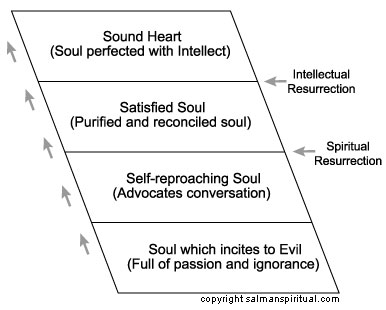
The above diagram shows the ascent of the soul. In the first stage, the soul which is full of passion and ignorance is cultured by the self-reproaching soul and purified till it goes through a spiritual resurrection when the evil is completely conquered. The purified and reconciled soul is then enlightened in a systematic way so that it can grow and develop capacity. The soul which is now adorned with waves of Nur and then goes through an intellectual (luminous) resurrection and becomes a Sound Heart (Qalb-i Salim). These are the two great transformations of the soul. The first one is about purification and expansion of the soul and the second one is about endowment of luminosity.
Here is a greater tawil of Qalb-i Salim (Sound Heart):
In verse (26:89) is mentioned qalb-i salim, the sound heart by which is meant a heart which has been illumined with the light of Imamat. In the case of such a mu’min, the Imam himself becomes his heart.
A Thousand Wisdoms, Tawil No. 697. p. 370
In the Ismaili Tariqah, the Holy Imam guides and accompanies the mu’min(a) in his/her personal search and keeps to charting the course of purification, expansion and strength of the soul and its enlightenment with the Noor of Imamat.
Let us reflect on the ascent of soul as described by William C. Chittick:
The Koran tells us to pray, “Guide us on the straight path” (1:5). Just as this straight path of return can be imagined as an ascent through an ever increasing intensity of light that opens up into the Infinite Light of God, so it can be envisaged in many other divine attributes. To increase in light is to increase in life, knowledge, desire, power, speech, generosity, justice and so on. This is the process of actualizing all the divine names that are latent within the primordial human nature by virtue of the divine form.
Chittick, W. C. The Sufi Path of Knowledge.SUNY Press, Albany, 1989. pp.351-2
I hope that the above wisdoms help us to appreciate and actualize the blessings of ‘spiritual enlightenment’ in the firmans of our present and living Imam, Noor Mowlana Shah Rahim Al-Hussaini Hazar Imam.
9. Being in the Presence of Lord (Mawla-y-i khud), Murtada ‘Ali
Here is an excerpt from the book titled ‘Pir Pandiyat-i Jawanmardi’:
The (real) believer is one who is always patient, pious, sincere and truthful, clean in his beliefs, and modest, whose heart is full of the fear of God, who is free from wrath and hatred, and is pure. In his every action he sees his Lord (Khudawand) present before him, always remembering God. Every slave of God who acts in this way will receive in this world splendour and affluence, and in the hereafter he will be in Paradise, in the presence of his Lord (Mawla-y-i khud), Murtada ‘Ali.
Pandiyat-i Jawanmardi, or “Advices of Manliness” is a collection of instructive religious and moral advices and maxims of Imam NOOR Mowlana Shah Mustansir bi’l-laah II. p.7
The transliteration of Hazrat Ali’s Kalame Mowla (The Sayings of Hazrat Ali) was published by the Shia Imami Ismailia Association of United Kingdom in 1975. Permalink to Aga Khan Library Record, London, UK. This 50-year milestone formally marks my personal search for knowledge and wisdoms in the field of higher spiritual enlightenment. These resources have been shared with the global Jamat and humanity at large through the SalmanSpiritual.Com website.
Shukhran Lillah Wal Hamdu Lillah
(All thanks are due to Allah, and all praises are due to Allah)
Yawm-e Ali Mubarak!
May Noor Mowlana Hazar Imam fill our spiritual hearts (Qalb) with his Noor and nothing else!
Angelic Salwat Supplication
Let us now start supplicating with angelic salwat, Allâhumâ salli alâ Muhammadin wa âle Muhammad (O Allah! Bestow Peace on and through Muhammad and his Descendants).
May our beloved NOOR Mowlana Shah Rahim Al-Hussaini Hazar Imam send blessings for mushkil aasan, and for material and spiritual upliftment.
Ameen
Bismillahir Rahmanir Rahim
In the name of Allah, the Most Beneficent, the Most Merciful
Al-hamdu lillahi rabbil 'alamin
Praise be to Allah, the Lord of the worlds!
Haizinda — Qayampaya
(Our Present Imam is Living and His NOOR is Eternal)